Project Profile and Business Consulting Services
Rimex International is a business consulting service firm specializing in Bankable Project Profile preparation and industrial consulting services. We provide technical, financial, investment, and business consulting to help clients plan, evaluate, and develop their projects.
Our professional consulting activities include collecting project information, analyzing technical feasibility, preparing financial models, evaluating commercial viability, and developing professional project reports. The result is a well-structured Bankable Project Profile prepared to support investment and financing decisions.
For more than a decade, Rimex International has been preparing Bankable Project Profiles, also known as Project Profiles, Feasibility Study Reports, Business Plans, Project Proposals, and Project Reports. A key part of a bankable project profile is the financial projection report, which presents the project's expected financial performance and helps assess its financial viability.
Our Bankable Project Profile services cover a wide range of industries, including Manufacturing, Agro & Livestock Farming, Trading & Service, Real Estate & Construction, and many other business sectors.
A well-structured and investor-ready Bankable Project Profile helps present a project clearly, demonstrates its technical and financial viability, builds confidence among investors and financial institutions, and supports informed investment decisions.
The Bankable Project Profile Preparation Service is our flagship consulting service because it combines comprehensive business, technical, operational, and financial analyses into a single integrated report. Depending on a client's specific requirements, we also prepare standalone Financial Projection Reports and Company Profile Designs as independent consulting services.
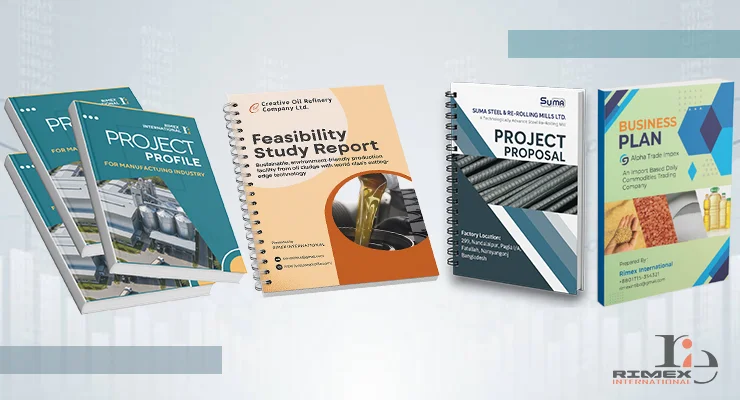
Bankable Project Profile Preparation Services
A Bankable Project Profile is a comprehensive report prepared to assess the feasibility and viability of a business project. Although these documents have different names, they all serve the same purpose—to demonstrate that a project is financially feasible, economically viable, technically sound, technologically appropriate, and environmentally sustainable. Therefore, they can collectively be referred to as a Bankable Project Profile.
A Bankable Project Profile is also known as a Project Profile,Feasibility Study Report, Business Plan, Project Proposal, Project Report, and so on.
A Bankable Project Profile presents reliable business, technical, market, and financial information to help entrepreneurs, investors, banks, financial institutions, stakeholders, startups, and other decision-makers evaluate a project's potential and make informed investment and financing decisions.
Before preparing a Project Profile it is considered type of sectors of the business as different business sectors have different characteristics in terms of revenue generation, credit facilities, and repayment methods. And for their different characteristic it requires different financial models.
An Industrial sector is categorized following the characteristics:
- Manufacturing Industry:
This sector involves the production of goods by transforming raw materials into finished products using mechanical, physical, or chemical processes.
- Agro & Livestock Farming Industry:
Businesses in this sector engage in farming, dairy, poultry, and forestry activities to produce raw materials such as crops, livestock, and timber.
- Real Estate and Construction Industry:
This sector involves the construction of infrastructure, residential and commercial buildings, and other structures.
- Trading & Service Industry:
This sector encompasses a wide range of activities that provide services to businesses in various industries without producing tangible goods.
- Hospitality and Tourism:
Businesses in this sector provide services related to travel, accommodation, and leisure activities
Then, following the characteristics of categorized industrial sector a Project Profile Format along with a Financial Model is structured and developed for better clarity and effectiveness of the Bankable Project Profile
Core and Key Contents of A Bankable Project Profile
- ✔ Executive Summary
- ✔ Market Potentiality
- ✔ Financial Performances
- ✔ Technical & Operational Aspects
- ✔ Management & Organization
- ✔ Economic Aspect
- ✔ Risks and Mitigation
- ✔ Implementation Schedule
Read More
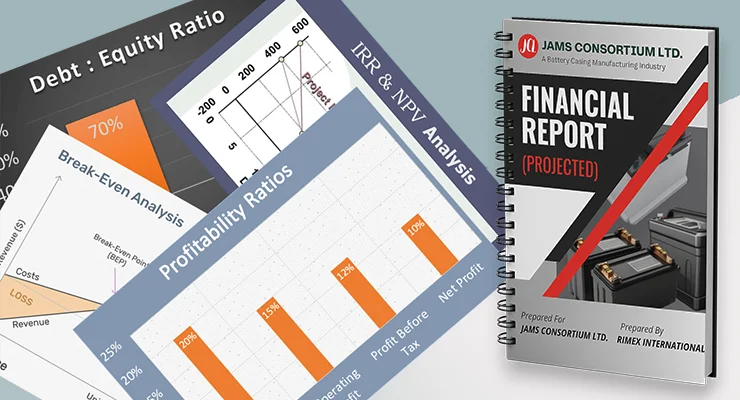
Financial Projection Report Preparation Services
A Projected Financial Report is one of the most important sections of a Project Profile, Feasibility Study Report, Business Plan, Project Proposal, or Project Report.
It projects the expected financial performance of a business by incorporating current market prices, underlying assumptions, production capacity, operating costs, and other key financial inputs into a structured financial model. The model applies appropriate formulas and financial functions to generate accurate financial projections. It helps determine whether a project is financially feasible, profitable, and capable of long-term growth.
A professionally prepared Projected Financial Report provides a clear financial roadmap for business success. It enables stakeholders to evaluate investment potential, monitor future performance, and make confident financial decisions, making it an essential document for project financing and sustainable business growth.
Why is a Fonancial Project Report Important?
- Evaluates the project's financial feasibility and profitability.
- Estimates investment, revenue, expenses, profit, and cash flow.
- Assesses loan repayment capacity and financial sustainability.
- Supports business planning, budgeting, and strategic decision-making.
- Identifies financial risks and improves investment confidence.
- Helps entrepreneurs, investors, and banks make informed financing decisions.
- Enhances the credibility of the project and increases the chances of securing funding.
Read More

Company Profile Designing Services
A Company Profile is a document or presentation that provides an overview of a business. It serves as a formal introduction to the company, outlining its history, mission, vision, products or services, achievements, and other key information. A company profile is often used as a marketing tool to attract customers, investors, or business partners.
Key Components of a Company Profile
- Company Name and Logo
The official name of the business and its logo for branding.
- Introduction/Overview
A brief introduction to the company, including its history and purpose.
- Mission and Vision Statements
The company’s goals and values that guide its operations.
- Products or Services
A description of the key offerings of the business.
- Unique Selling Proposition (USP)
What makes the company stand out from its competitors.
- Organizational Structure
Details about ownership, management team, and staff.
- Business Location and Facilities
Information about the company’s headquarters, branches, and infrastructure.
- Market and Target Audience
Insights into the market the company serves and its customer demographics.
- Achievements and Milestones
Awards, certifications, or significant milestones in the company's history.
- Corporate Social Responsibility (CSR)
Any initiatives taken to contribute to society or the environment.
- Financial Overview (Optional)
Key financial metrics or growth trends, if applicable.
- Contact Information
How customers or stakeholders can reach the company.
Purpose of a Company Profile
- Marketing Tool: To attract potential clients or investors.
- Credibility: Establishes trust and professionalism.
- Branding: Highlights the company’s identity and values.
- Recruitment: Helps attract talent by showcasing company culture.
- Networking: Acts as a business card for partnerships and collaborations.
Read More